
Pacific Starbase: What It Would Take to Launch SpaceX's AI Satellites from the Philippines
Not legal advice. The author is a US patent attorney, admitted in Colorado. He is not admitted to practice law in the Philippines. This is policy analysis of public material, not a legal opinion on Philippine law.
Executive summary
A Philippine site makes sense for SpaceX as a Pacific gateway for AI satellites into dawn-dusk polar orbit, alongside Louisiana rather than instead of it. Physics does not decide where. The corridor, the ship's return path, and the daily launch windows decide, and on all three the eastern Mindanao coast passes. Lal-lo, the government's chosen site, is well suited to sounding rockets and SpaceX's 30° shell, but cannot reach dawn-dusk polar orbit cleanly. [I]
Five findings
- Polar orbit costs the same everywhere. Launching against Earth's rotation into a 97.6° dawn-dusk orbit costs about 470 m/s more than a 30° launch, roughly 58 t of a V4's 200 t payload. The cost is nearly identical from Louisiana or Mindanao, so latitude is not the discriminator. [I]
- Corridors and dog-legs are. A 5° dog-leg to avoid land costs another 27–54 t, depending on where in the ascent it is flown. Lal-lo cannot reach dawn-dusk orbit cleanly with any dog-leg up to 12°. In business terms, a 5 t penalty on every daily launch leaves about 900 satellites a year on the ground. Pusan Point in Davao Oriental is the only shortlisted site usable in both directions, needing at most a 1° dog-leg. [I]
- Each launch carries about 70 AI1 satellites, or 8.5 MW of compute, if the AI1 weighs about 2 t (bounded 1.2–2.5 t; SpaceX has not published its mass, and one published critique puts it nearer 6 t, which would cut these figures by about two-thirds). At one launch a day, the site adds about 3 GW of orbital compute a year, about 3% of SpaceX's stated goal of 100 GW a year. [I]
- The ship comes home from the north. Returning from orbit to the launch tower, every Philippine candidate has a clean final 1,500 km if the ship arrives from the north. The tracks pass well upstream over Japan or Korea at high altitude. [I]
- Gas is the critical commodity. At one launch a day the site needs about 150 MW around the clock, most of it to make liquid oxygen from air, and about 0.83 million metric tons of LNG a year. Solar would need about a fifth of an island the size of Jomalig at that cadence, and more than half at three launches a day. [I]
The bottlenecks that bind first (full register below) [I]
| # | Bottleneck | Type | Why it binds |
|---|---|---|---|
| 1 | US–Philippines Technology Safeguards Agreement | Schedule | No US launch from Philippine soil without one |
| 2 | Gas supply: 0.15–2.4 Mt of LNG a year | Operational | Every launch and every megawatt depends on it |
| 3 | Oxygen plant and power: 5,700–17,000 t a day | Engineering | 78% of propellant; sets site power |
| 4 | Dawn-dusk launch windows | Orbital and operational | One window a day per direction per orbital plane; caps cadence at one-direction sites |
| 5 | Land, hazard buffer, indigenous consent, and turbine air permits | Schedule | Gate construction; litigation risk |
How to read this
What this is. A Corridor Intelligence Special Edition: an engineering assessment of what it would take for SpaceX to launch its AI data-center satellites from the Philippines. It is informed speculation. The Philippine government has confirmed early talks with SpaceX about a launch complex, and nothing more; SpaceX has not commented. The aim is to set out what such a site involves.
How it is built. Every figure is one of three kinds, and labeled:
- [D] Documented: from a public source listed at the end.
- [A] Assumption: a stated input, listed in the assumptions register with what changes if it is wrong.
- [I] Inference: the author's reasoning or a computed result.
Computed figures come from four short scripts, available on request: corridor geometry, orbital trades, mass and energy balance, and fleet throughput. Nothing is estimated in prose.
Time frame. The analysis is set where SpaceX says it is going, not where it is today. It assumes Starship V4 flying operationally, both stages caught at the tower and rapidly reused, and the AI-satellite constellation in production. In SpaceX's stated timeline that is roughly 2030 onward. The study asks what a Philippine site would need in that world.
Structure. Design basis and assumptions come first, then the constraints in four families: orbital, engineering, operational, and regulatory and schedule. The bottleneck register then gathers every binding constraint in one table, with its lead time, the lever that loosens it, and the signpost that shows it moving. Site choices follow from the constraints.
Trademarks and affiliation. SpaceX, Starship, Super Heavy, Raptor, Starlink, Starmind, AI1, Megapack, and Megablock are trademarks of their owners. Corridor Intelligence is independent. It has no affiliation with, information from, or endorsement by SpaceX, Tesla, or any government, and nothing here describes an actual plan.
What is on the record
As of November 21, 2026:
| Date | Event | Why it matters here |
|---|---|---|
| Feb. 12, 2025 | Ambassador Romualdez: Musk is interested in a SpaceX launch pad in Mindanao, citing its nearness to the equator; DICT calls the talks exploratory [D] | The earliest public mention found, and the right region for the wrong reason: latitude does not help polar launches (Finding 1); the corridors do |
| Jan 2026 | SpaceX applies to the FCC for up to one million orbital data-center satellites; a later supplement places 500,000 in dawn-dusk sun-synchronous orbits at 565–1,002 km [D] | Half the constellation needs a polar launch |
| Jan–Mar 2026 | Musk: "We're doing 100 kilowatts per ton"; SpaceX's filing: one million metric tons a year at 100 kW per metric ton would add 100 GW of AI compute a year [D] | Sets the mass logic for AI satellites |
| Jun 2026 | AI1 unveiled: about 20 m high with a 70 m wingspan, 150 kW peak and about 120 kW average compute [D]; Gigasat factory in Bastrop, Texas, aiming at about 1 GW a year by end-2027, or more than 6,000 AI1 [D] | The payload this site would fly |
| Aug 2026 | Starmind constellation named; launches of thousands of satellites from 2027 [D] | Demand starts before any Philippine site could exist |
| Aug. 25, 2026 | Starbase Louisiana: $100 billion, ~125,000 acres, 10 pads, propellant and power on site, first launch 2029 [D] | The template, and the competitor |
| Oct 2026 | Musk: 10,000 Starship launches a year "just from Starbase Louisiana" [D] | The scale SpaceX plans in the US alone |
| Nov. 14, 2026 | Flight 15: the ship flies 14 orbits over 22.5 hours and is caught by the launch tower for the first time; the booster is lost in the Gulf [D] | Full return to the launch site is now demonstrated, once |
| Nov. 16, 2026 | Musk outlines Starship V4: about 70 m ship, nine engines, more than 60% more propellant, payload above 200 t [D] | The vehicle this study is sized to |
| Nov. 20, 2026 | President Marcos confirms early discussions with SpaceX on a possible launch complex, separate from PhilSA's Lal-lo sounding-rocket project [D] | The opening |
No site, commitment, or timetable has been disclosed. On November 19, Ambassador Romualdez told ANC: "From what I'm told, Elon Musk comes here quietly very often because he has one or two islands, I'm told, that he's developing." Neither Musk nor his companies have confirmed it. [D] The Philippines signed the Artemis Accords on October 27, 2025, a step toward US space alignment ahead of any safeguards agreement. [D]
Design basis
The vehicle: Starship V4
| Parameter | V3 (flying) | V4 (announced; used here) |
|---|---|---|
| Ship | 52 m; 3 Raptor + 3 Raptor Vacuum [D] | About 70 m; 9 engines, all higher-thrust V4 Raptors [D] |
| Ship propellant | 1,600 t [D] | More than 60% more; 2,560 t used [D] |
| Booster propellant | 3,650 t [D] | 4,050 t, planned [D] |
| Payload to low orbit, reusable | More than 100 t [D] | More than 200 t [D] |
| Recovery | Booster and ship caught at the tower [D] | Same, routinely [A] |
| Propellant cost goal | — | Below $500,000 a flight [D] |
The payload: AI1 satellites
SpaceX has published the AI1's size and power but not its mass. [D] Musk's working figure for the whole system is 100 kW of compute per metric ton. [D] This study bounds the mass [A]:
| Case | AI1 mass | Basis | Per V4 launch to dawn-dusk orbit (142 t) | Per V4 launch to the 30° shell (200 t) |
|---|---|---|---|---|
| Low | 1.2 t | Musk's 100 kW per metric ton at 120 kW average compute | 118 satellites, 14.2 MW | 166 satellites |
| Base | 2.0 t | Reported bus mass above 2 t; a reported 70 kW per metric ton at 150 kW | 71 satellites, 8.5 MW | 100 satellites |
| High | 2.5 t | Base plus propellant and structural growth | 56 satellites, 6.7 MW | 80 satellites |
The study assumes loads are limited by mass, not volume. With a 70 m wingspan folded inside a 9 m fairing, volume may bind first; the longer V4 ship helps. [A]
Critic case. The 2 t base case is, in effect, SpaceX's own implied number: 150 kW at a claimed 70 kW per metric ton. A published critique argues that once radiators, oversized arrays, batteries, and structure are counted honestly, the AI1 is closer to 24 kW per metric ton, or about 6 t. [D] At 6 t a V4 carries about 23 AI1s to dawn-dusk orbit (2.8 MW of compute) and 33 to the 30° shell. Daily launches would then add about 1 GW a year rather than 3. The site logic does not change, but every compute-per-launch figure in this edition falls by about two-thirds, and each metric ton lost to a dog-leg costs fewer satellites. [I]
Why satellite mass shapes the site. Every metric ton lost to geometry is a satellite not flown. On the base case, each 2 t of payload lost to a dog-leg or a corridor detour is one AI1, or 120 kW of orbital compute, left on the ground. Over a year of daily launches, a 5 t penalty per flight costs about 900 satellites. A clean corridor is worth more than any other site attribute. [I]
Cadence and throughput (base case)
| Phase | Indicative years | Pads | Launches a year | AI1 a year | Compute added a year | Share of SpaceX's 100 GW-a-year goal |
|---|---|---|---|---|---|---|
| 1. Pathfinder | 2030 | 1 | 52 | 3,700 | 0.44 GW | 0.4% |
| 2. Daily | 2031–32 | 2 | 365 | 25,900 | 3.1 GW | 3.1% |
| 3. High cadence | 2033 on | 2 | 1,095 | 77,700 | 9.3 GW | 9.3% |
The years are indicative, set two to four years behind Louisiana's 2029 first launch. [A]
The fleet: rapid reuse
SpaceX's model is aircraft-like reuse: both stages caught at the tower, inspected, and restacked. [D] This study assumes a mature version of it [A]: boosters last 100 flights with a one-day turnaround; ships last 30 flights (the heat shield is the life limit) with a three-day turnaround plus a day in orbit; 1% of flights lose a vehicle.
| Phase 1 | Phase 2 | Phase 3 | |
|---|---|---|---|
| Boosters in rotation (with spare) | 2 | 2 | 4 |
| Ships in rotation (with spare) | 2 | 5 | 13 |
| New boosters needed a year | 1 | 6 | 16 |
| New ships needed a year | 2 | 14 | 42 |
| Raptor engines a year, for new stages | 44 | 308 | 919 |
Ships, not boosters, drive replacement. At Phase 3 a new ship is needed almost every week, which is the strongest argument for eventually building stages near the site. [I]
Assumptions register
Every input the analysis rests on but cannot source directly. The last column says what moves if the assumption is wrong.
| ID | Assumption | Value used | Basis | If wrong |
|---|---|---|---|---|
| A1 | V4 is the operational vehicle | 6,610 t propellant; 200 t to low orbit | Musk, Nov. 16, 2026 | On V3, payload halves and launches double for the same compute |
| A2 | AI1 mass | 2.0 t (bounds 1.2–2.5 t) | Bounded from published power and Musk's 100 kW per metric ton | Satellites per launch range 56–118 |
| A3 | Loads limited by mass, not volume | — | V4's longer ship | If volume binds, fewer satellites per launch and payload penalties matter less |
| A4 | Satellites inserted at their final inclination and raise their own altitude | Insertion at about 300 km, 97.6° | Starlink practice | Direct insertion to 565–1,002 km costs more payload everywhere, equally |
| A5 | Both stages caught at the launch tower | Booster and ship return to launch site | Demonstrated once, Nov. 14, 2026 | Ocean recovery would remove return-corridor constraints and add ships and barges |
| A6 | Reuse life | Booster 100 flights; ship 30; 1% losses | Aircraft-like reuse goal | Shorter ship life raises replacement shipping sharply |
| A7 | Engines accepted in the US | Raptors tested at McGregor, Texas; static fires on the launch mount only; no engine test stand at the site | SpaceX's McGregor role | An on-site test stand adds land, noise, and permits |
| A8 | Stages built in Texas at first | Shipped by sea until Phase 3 | Current factory footprint | A local stage factory moves earlier if shipping proves slow |
| A9 | Mixture ratio and losses | Oxidizer-to-fuel 3.6; 10% losses | Typical Raptor figure; engineering allowance | ±10% on propellant and power |
| A10 | Oxygen plant energy | 0.5 MWh/t of liquid oxygen (range 0.3–0.9) | Published plant data | Phase 2 power 100–240 MW; the largest single sensitivity |
| A11 | Power from gas turbines, simple cycle with heat recovery | 38% electrical; exhaust heat drives air precooling and desalination | Typical; SpaceX's own turbine program | Full combined cycle would cut fuel gas by about 30% but needs a steam plant and 2+ years of heavy civil work — and it would use the heat the chillers need |
| A12 | Propellant methane from imported LNG | Purified and subcooled on site | No gas grid on the Pacific coast | A pipeline would add liquefaction load |
| A13 | Deluge water | 1,325 m³ a launch, half recovered | FAA 2022 assessment | Not material; water is never binding |
| A14 | Cadence phases | 52 / 365 / 1,095 launches a year | SpaceX's stated ambitions, scaled to two pads | Scales the balance linearly |
| A15 | Corridor metric | Share of land under the first 2,000 km of ascent ground track; last 1,500 km of return | Proxy for overflight risk | Real trajectories dog-leg and loft; treat as a screen, not a range-safety analysis |
Constraints 1: orbital
The polar penalty is the same everywhere
A dawn-dusk orbit at 565–800 km sits at about 97.6° inclination, slightly retrograde. A rocket heading there launches a few degrees west of due north or south, so Earth's eastward spin works against it instead of helping. [I]
| Site | Latitude | Ground speed east | Rotation help, 30° orbit | Rotation help, dawn-dusk orbit | Polar penalty | V4 payload lost |
|---|---|---|---|---|---|---|
| Pecan Island, Louisiana | 29.7°N | 404 m/s | +403 m/s | −64 m/s | 467 m/s | ~58 t |
| Lal-lo, Cagayan | 18.2°N | 442 m/s | +401 m/s | −66 m/s | 467 m/s | ~58 t |
| Jomalig, Quezon | 14.7°N | 450 m/s | +400 m/s | −67 m/s | 467 m/s | ~58 t |
| Homonhon, Eastern Samar | 10.7°N | 457 m/s | +400 m/s | −67 m/s | 467 m/s | ~58 t |
| Pusan Point, Davao Oriental | 7.3°N | 461 m/s | +399 m/s | −68 m/s | 467 m/s | ~58 t |
The penalty is computed at a 300 km insertion (A4) and converted to payload at about 0.124 t per m/s for the V4 ship. That rate assumes a 200 t ship dry mass; a range of 150–300 t gives 0.107–0.160 t per m/s. [A] [I]
The result is counter-intuitive and important. Lower latitude does not help polar launches; it slightly hurts. Louisiana, Luzon, and Mindanao all deliver about 142 t to dawn-dusk orbit. Site choice for AI satellites is about the corridor, not the latitude. [I]
Dog-legs: what avoiding land costs
A dog-leg is a sideways turn during ascent that keeps the rocket over water and then turns it back onto the target orbit. Its cost is the plane change, and that cost grows with the vehicle's speed at the moment of the turn. [I]
| Dog-leg | Early, in booster phase (~2.5 km/s) | Mid-ascent, ship phase (~5 km/s) | At orbital speed (~7.7 km/s) |
|---|---|---|---|
| 1° | 44 m/s · 5 t · 12,000 lb | 87 m/s · 11 t · 24,000 lb | 135 m/s · 17 t · 37,000 lb |
| 2° | 87 m/s · 11 t · 24,000 lb | 175 m/s · 22 t · 48,000 lb | 270 m/s · 34 t · 74,000 lb |
| 5° | 218 m/s · 27 t · 60,000 lb | 436 m/s · 54 t · 119,000 lb | 674 m/s · 84 t · 184,000 lb |
| 10° | 436 m/s · 54 t · 119,000 lb | 872 m/s · 108 t · 238,000 lb | 1,347 m/s · 167 t · 368,000 lb |
Read the table as a first-order upper bound on payload lost from the ~142 t to dawn-dusk orbit. Early dog-legs are cheaper but use booster propellant that is held for the flight back to the tower, so in practice they shrink the booster's return margin rather than the ship's payload. In AI1 terms, a 5° mid-ascent dog-leg costs about 27 satellites a launch, or 3.2 MW of compute. [I]
What each site needs
Share of land under the first 2,000 km of the ascent track at 97.6°, and the smallest inclination offset that brings it to 5% or less (tested to 12°). [I]
| Site | Northbound | Southbound | Dog-leg needed | Verdict |
|---|---|---|---|---|
| Pusan Point | 6% (1° brings it to 4%) | 3% | None southbound; 1° northbound | Usable both ways |
| Homonhon | 3% | 35% | None northbound | Northbound only |
| Patnanungan | 57% | 4% | None southbound | Southbound only |
| Jomalig | 59% | 5.5% (0.5° brings it to 4%) | 0.5° southbound | Southbound only; a needle: at 96.7° the track crosses Sulawesi |
| Lal-lo | 67% (Taiwan, China) | 29% (down Luzon) | None found within 12° | Cannot reach dawn-dusk orbit cleanly |
| Pecan Island (reference) | 100% | 15% (Mexico) | None found within 12° | SpaceX accepts the overflight [I] |
Pecan Island is the calibration point. SpaceX chose a site whose southbound polar corridor crosses Mexico's Isthmus of Tehuantepec, so it evidently plans to accept about 15% overflight, or to fly a mitigation this simple screen cannot see. Every usable Philippine direction is cleaner. [I]
Launch windows: the hidden cadence cap
A dawn-dusk orbit is fixed relative to the Sun. A site passes under a given orbital plane twice a day, about 12 hours apart: once heading north and once heading south, near local dawn and dusk. A site usable in only one direction therefore gets one window a day per orbital plane, each a few minutes wide. [I]
- Pusan Point has two windows a day per plane.
- Homonhon, Jomalig, and Patnanungan have one window a day per plane.
- The lever is to spread the constellation across planes with different local times of ascending node (LTAN), say 05:00 to 07:00 rather than a single 06:00. That widens the daily launch block from minutes to about two hours. Altitude shells alone do not help: planes at the same LTAN pass over the site at the same local time. Using both pads in the same window also helps. That makes the launch range, not the pad, the constraint at Phase 3. [I]
Return: the ship comes home
The ship deploys its satellites and returns to the tower that launched it, as Flight 15 did after 14 orbits and 22.5 hours. [D] To land, the ship must pass back over the site, either about 12 hours after launch on the opposite pass or about a day later on the same pass. Its re-entry track runs upstream along the orbit for thousands of kilometers, and the final 1,500 km, low and slow, matters most (Figure D1). [I]
| Site | Arriving from the north: last 3,000 km / last 1,500 km over land | Arriving from the south | Best return | Same pass as launch? |
|---|---|---|---|---|
| Pusan Point | 0% / 0% | 35% / 14% (Halmahera, northern Australia) | From the north | Southbound launch: yes. Northbound: no |
| Homonhon | 11% / 0% (Kyushu, far upstream) | 33% / 35% | From the north | No: launches north, returns south-bound |
| Jomalig | 23% / 0% (Korea, far upstream) | 16% / 28% (Visayas) | From the north | Yes |
| Patnanungan | 25% / 2% | 17% / 26% | From the north | Yes |
| Lal-lo | 27% / 1% | 22% / 40% | From the north | — |
| Pecan Island (reference) | 97% / 100% | 29% / 34% (Yucatán, Guatemala) | From the south | No |
Three consequences [I]:
- Every Philippine site has a clean final approach from the north. The upstream track crosses Japan or Korea while the ship is still very high and fast. That needs a notification arrangement with Tokyo or Seoul, not consent to fly low over them.
- At Jomalig and Patnanungan, launch and return use the same daily window. A ship returning on the morning of a launch competes for the same minutes and the same range. A dedicated catch tower, or a third pad, is the lever.
- Homonhon and Pusan Point separate launch from return, launching on one pass and catching on the other. That is the cleaner operation.
Site operations at a glance
Launch direction, return direction, and daily windows per orbital plane, drawn from the three tables above. [I]
| Site | Clean launch direction | Best return | Windows a day per plane | Launch and return |
|---|---|---|---|---|
| Pusan Point | Both (northbound with a 1° dog-leg) | From the north | 2 | Separate on a northbound launch; shared on a southbound one |
| Homonhon | Northbound | From the north | 1 | Separate passes |
| Jomalig | Southbound (0.5° dog-leg) | From the north | 1 | Same window; a third pad or catch tower is the lever |
| Patnanungan | Southbound | From the north | 1 | Same window |
| Lal-lo | None clean within 12° | From the north | 0 clean | — |
| Pecan Island (reference) | Southbound, accepting 15% overflight | From the south | 1 | Separate passes |
Cross-range. A returning ship is not locked to its ground track. Its body and flaps give it hypersonic cross-range of the order of hundreds of kilometers, so the upstream track can be bent away from Yonaguni, Kyushu, or Korea if needed. That is an operational lever; it does not change the basic advantage of a northern ocean approach. [I]
Hazard and bail-out zones
- Booster. It returns to the tower, so in nominal flight there is no downrange drop zone. V3 removed the jettisoned hot-staging interstage [D], so no ring falls downrange either. A failed booster falls within the first few hundred kilometers, which is open ocean in every usable direction above. [I]
- Ship ascent abort. Until orbit, the ship's impact point sweeps along the corridor, so the land share above doubles as an abort-risk screen. The bail-out zones are the Philippine Sea northbound and the Celebes and Banda Seas southbound. [I]
- Re-entry abort. A ship that cannot reach the tower ditches along the return track. Arriving from the north, that is the open Philippine Sea. [I]
- Closures. Each launch and each return closes airspace and sea lanes along the corridor. At Phase 3 that means up to six closures a day, three launches and three returns, across shipping lanes and fishing grounds. [I]
The contrast with today's launches. The Philippines already lives under other countries' launch hazards. PhilSA routinely warns of debris from Chinese Long March launches falling in Philippine waters. The most recent warning, on November 9, 2026, concerned suspected debris near Palawan, and the Navy has recovered debris near Tubbataha Reef Natural Park. [D] PhilSA has called on international partners to develop protocols on rocket debris. [D] A fully reusable Starship drops no spent stages: booster and ship both return to the tower. For a Philippine public used to debris advisories, that is a material difference, and a political lever. [I]
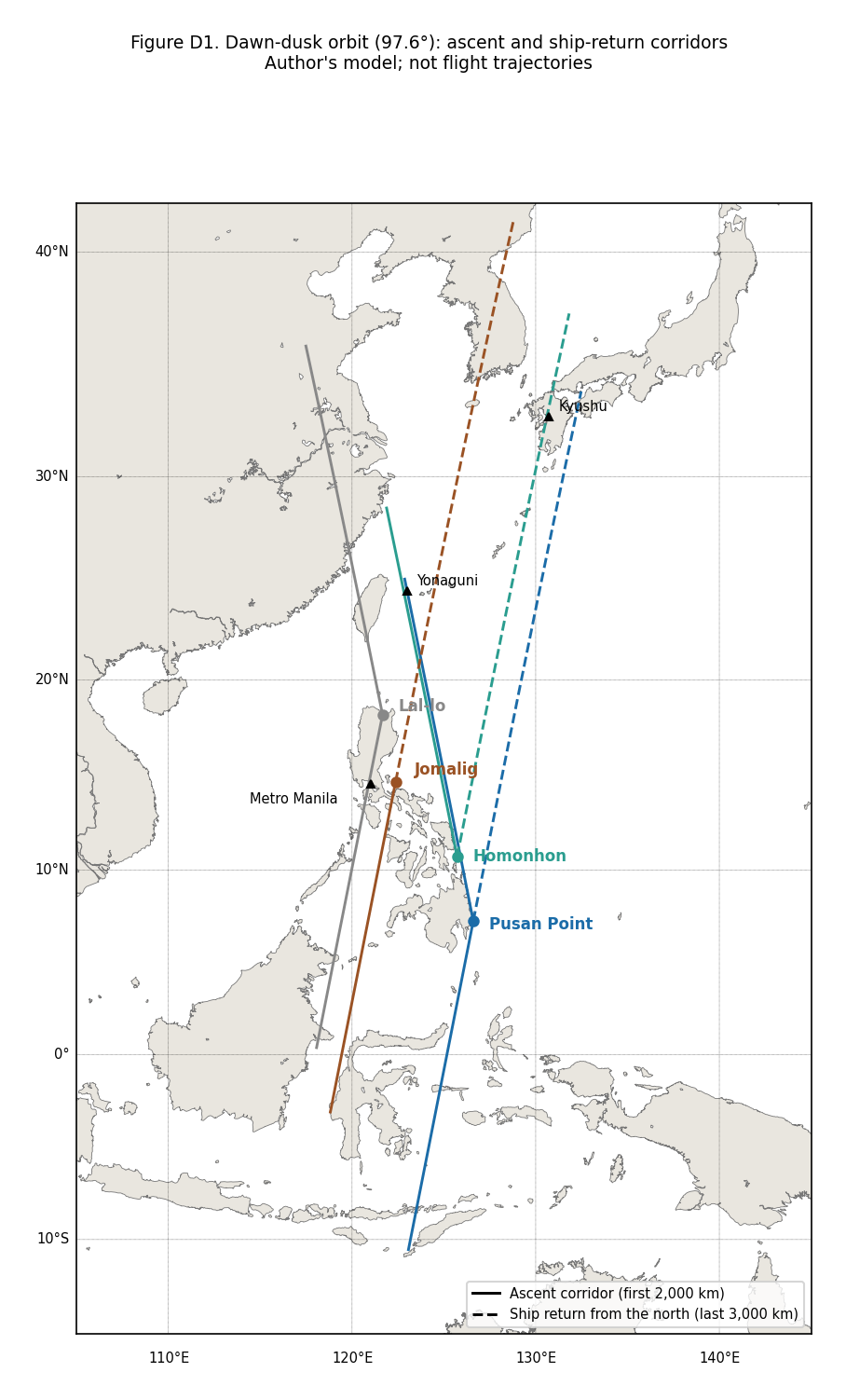 Figure D1. Dawn-dusk orbit at 97.6°: clean ascent corridors (solid) and ship returns from the north (dashed) for the four sites tested in this section. Lal-lo (gray) shown for contrast; both of its corridors cross land. Author's model, not flight trajectories.
Constraints 2: engineering
Mass and energy balance
One V4 launch loads about 7,300 t of propellant including losses: 5,690 t of liquid oxygen and 1,581 t of methane. Oxygen is made from air; methane is shipped in (Figure D3). Oxygen is 78% of the load, so a launch site's capacity is set by its power plant. [I]
| Per year, V4 | Phase 1 | Phase 2 | Phase 3 |
|---|---|---|---|
| Launches | 52 | 365 | 1,095 |
| Liquid oxygen | 0.30 Mt | 2.08 Mt | 6.23 Mt |
| Methane propellant | 82 kt | 577 kt | 1.73 Mt |
| Average electric load | 43 MW | 147 MW | 391 MW |
| of which oxygen plant | 17 MW | 119 MW | 356 MW |
| LNG burned for power (simple cycle) | 72 kt | 249 kt | 663 kt |
| Total LNG (propellant plus power) | 0.15 Mt | 0.83 Mt | 2.39 Mt |
| Water | 0.58 million m³ | 0.79 million m³ | 1.27 million m³ |
What else draws power. The non-oxygen load is about 26 MW at Phase 1, 29 MW at Phase 2, and 35 MW at Phase 3. Most of it is a site base of 25 MW, assumed for payload processing, hangars and stacking, cryogenic pumping and transfer, and housing and port services. [A] Methane purification adds 0.5, 3.3 and 9.9 MW across the phases, and desalination under 1 MW. Once launches are daily, the oxygen plant is more than 80% of the site's electricity. [I]
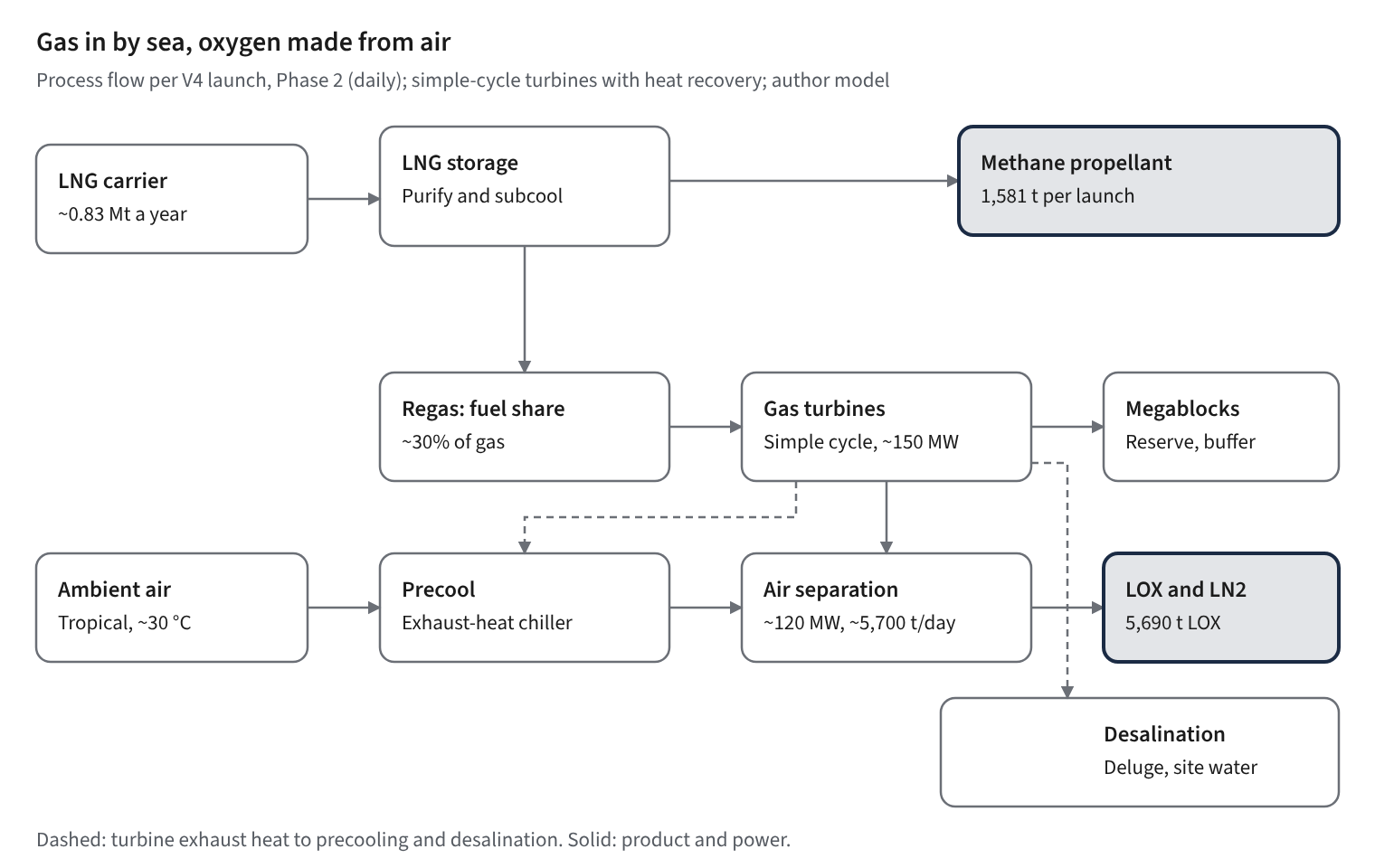
Figure D3. Gas in by sea, oxygen made from air: process flow per V4 launch at Phase 2 (daily). About 30% of the gas fuels roughly 150 MW of simple-cycle turbines; exhaust heat drives precooling and desalination. Author's model.
Oxygen plant
At Phase 2 the plant makes about 5,700 t of liquid oxygen a day, the scale of one large industrial train. Phase 3 needs about 17,000 t a day, the class of the largest multi-train complexes, which exceed 15,000 t a day. [D] Plant energy is the study's largest uncertainty: at 0.3–0.9 MWh/t, Phase 2 needs 100–240 MW. Two tropical design points [I]:
- Precooling. Intake air at 30°C costs compressor power; absorption chillers on turbine exhaust heat recover part of it.
- LNG cold. Using regasifying LNG as a heat sink can cut oxygen-plant energy by about a third. [D] Here only the fuel share of the gas, about 30%, is regasified; the rest is burned as liquid propellant. The gain is a few megawatts.
Power: turbines, Megablocks, and why not solar
SpaceX's own playbook already answers this. It has applied in Texas for 35 gas turbines totaling 748 MW, committed $2.8 billion to turbines, and is casting turbine blades in-house. [D] Musk: natural gas "will still be needed to supplement and bootstrap solar for several years." [D]
Simple cycle is the base case. Turbines in the ~21 MW class are deployed in simple cycle for speed and modularity: about 38% electrical efficiency, with exhaust heat recovered for air precooling and desalination rather than for a steam cycle. Full combined cycle would cut fuel gas by about 30%, but it needs steam turbines, condensers, and two or more years of heavy civil work, and it would use up the heat the chillers depend on. It is a later-phase upgrade, not the starting point. [I]
| Phase 1 | Phase 2 | Phase 3 | |
|---|---|---|---|
| Design capacity (1.25 × average) | 53 MW | 184 MW | 489 MW |
| Turbines at ~21 MW (Texas average unit), simple cycle | 3 + 1 spare | 9 + 2 | 23 + 3 |
| LNG burned for power | 72 kt | 249 kt | 663 kt |
| Megablock reserve (two turbines out, four hours) | 9 (180 MWh), under an acre | 9 | 9 |
| Solar alternative: capacity for 24-hour supply | 251 MWac | 866 MWac | 2,300 MWac |
| Solar land (LBNL 2022, modern fixed-tilt: 0.28 MWac per acre) [D] | 363 ha | 1,252 ha | 3,324 ha |
| Sensitivity: solar land on the older NREL 2013 benchmark (7.9 acres per MW) [D] | 801 ha | 2,767 ha | 7,354 ha |
| Storage for 14 hours (Megablocks) | 30 | 103 | 274 |
| Solar land as a share of Jomalig (5,665 ha), LBNL 2022 (NREL 2013 sensitivity) | 6% (14%) | 22% (49%) | 59% (130%) |
Land figures use the LBNL 2022 empirical density for modern fixed-tilt plants. The older NREL 2013 benchmark needs about 2.2 times the land and is shown as a sensitivity. Even on the modern figure, solar is land-bound and typhoon-exposed. Gas plus a Megablock reserve fits in a few hectares. [I]
Methane and water
- Methane. Starbase Texas is moving to pipeline gas (Starpipe, due January 2027) feeding an on-site liquefaction plant. [D] The Philippines has no gas grid on its Pacific coast, and the Malampaya field is expected to be depleted by 2027. [D] Imported LNG, purified to propellant grade and subcooled with liquid nitrogen from the oxygen plant, is the only practical route. Liquefying regasified gas instead would add about 20 MW at Phase 2 for no gain. [I]
- Water. The deluge uses up to 350,000 gallons a launch. [D] At Phase 2 the whole site needs about 2,200 m³ a day: a small desalination plant, or multi-effect distillation on turbine exhaust heat, plus a retention basin. Water is never the binding constraint. [I]
Natural hazards: typhoons, earthquakes, and tsunamis
Typhoons. Typhoon frequency falls toward the equator, and Mindanao rarely sees strong typhoons. [D] Pusan Point, at 7.3°N, sees fewer storms than Homonhon at 10.7°N or the Polillo group at 14.7°N. Fewer is not none. Bopha (Pablo), the only Category 5 typhoon on record to make landfall on Mindanao, came ashore at Baganga, Davao Oriental, in December 2012, the municipality next to Caraga, and killed people in Caraga itself. [D] Every site needs catch towers, cryogenic tanks, LNG berths, and turbine halls built to Philippine structural wind zones. The study assumes no launches during typhoon passage and holds 30 days of LNG in reserve. [A]
Earthquakes and tsunamis. The Philippine Trench runs offshore along the whole eastern seaboard of the Visayas and Mindanao. On October 10, 2025 a magnitude 7.4 earthquake offshore Davao Oriental, at 7.07°N 127.06°E, about 55 km from Pusan Point, prompted a destructive-tsunami warning for Davao Oriental, Eastern Samar, and five other provinces. [D] PHIVOLCS warns that eastern coastal communities would have only 2 to 15 minutes to evacuate after a magnitude 8.7 trench earthquake. [D] Every shortlisted site faces the trench. Towers, cryogenic tanks, and the LNG jetty need seismic design loads and setback or elevation above tsunami run-up. Crews need a vertical-evacuation plan, and the LNG jetty is the most exposed asset. [I]
Constraints 3: operational
Gas: the critical commodity
| Phase 1 | Phase 2 | Phase 3 | |
|---|---|---|---|
| LNG a year (propellant plus simple-cycle power) | 0.15 Mt | 0.83 Mt | 2.39 Mt |
| Small-carrier loads (30,000 m³) | 11 | 61 (more than one a week) | 177 (about three a week) |
| Conventional-carrier loads (170,000 m³) | 2 | 11 | 31 |
| 30-day typhoon reserve on site | ~13 kt (~29,000 m³) | ~69 kt (~153,000 m³) | ~200 kt (~443,000 m³) |
For scale, the Philippines imported 1.58 Mt of LNG in the first ten months of 2025 through two terminals, both in Batangas. [D] Its terminals are significantly underused, according to the energy secretary. [D] Phase 2 alone would add more than 40% to the national import pace; Phase 3 would more than double it. [I]
Levers. A long-term supply contract; a dedicated small-carrier shuttle, from Batangas if a terminal can reload, or direct from exporters; on-site storage sized for the typhoon season; and propellant-grade purification sized for the cargo actually bought. [I]
Fleet and hardware flow
Under the rapid-reuse assumptions (A5, A6), the site holds a small flying fleet and receives a steady stream of new stages and engines. [I]
| Flow | Phase 2 | Phase 3 | Route |
|---|---|---|---|
| New ships a year | 14 | 42 | By sea from Texas; a local line at Phase 3 |
| New boosters a year | 6 | 16 | By sea from Texas |
| Raptor engines a year (new stages only) | ~310 | ~920 | Air or sea from McGregor and Hawthorne, accepted in the US [D] |
| AI1 satellites a year | ~26,000 | ~78,000 | From Bastrop's Gigasat factory [D] |
| Satellite containers a week, at ~70 per launch | ~7 launch-loads | ~21 launch-loads | Sea freight, US-controlled processing |
The Raptor counts cover new stages only. Mid-life engine swaps and overhauls come on top, so read them as a floor. Engines arrive already accepted at McGregor (A7), and the site does static fires on the launch mount only. That keeps an engine test stand, with its noise, land, and permits, out of the Philippines, and it keeps Raptors inside the custody regime of the safeguards agreement. [I]
Satellite flow is the overlooked operational load. At Phase 2 the site receives a launch-load of satellites every day, about 140 t, from a factory 13,000 km away. Payload processing must be fast, secure, and under US custody. [I]
What gets built where
One rule follows from the balance: make oxygen where you fly, and ship methane. [I]
| Item | Where | Why |
|---|---|---|
| Stacking, catch, turnaround | Pad site | Vehicles return to the tower they launch from |
| Liquid oxygen and nitrogen | Pad site | 78% of the load; made from air; cannot practically be shipped |
| Methane conditioning and storage | Pad site | LNG arrives by sea |
| Turbines and Megablocks | Pad site, or an energy island | The oxygen plant is the load |
| Desalination | Pad site | Small; runs on exhaust heat |
| Payload processing | Pad site or nearby port, under US custody | One launch-load a day |
| Ship and booster structures | Texas first; a port factory at Phase 3 | 42 new ships a year justifies a local line |
| Raptor engines | US only | Acceptance testing at McGregor; safeguards custody |
| AI1 satellites | US (Bastrop) | Factory scale already exists |
| Turbines and Megablocks | Imported from SpaceX's and Tesla's own supply | Vertical integration |
Range operations
At Phase 3 the range handles three launches and three returns a day, inside dawn and dusk windows, with booster returns minutes after each launch. The range control center, tracking, and airspace and maritime coordination with CAAP and the Coast Guard become a 24-hour operation. That is a capability the Philippines does not yet have, and it has to be built. [I]
Constraints 4: regulatory and schedule
Land under RA 12252, indigenous consent under IPRA, environmental compliance, and the treaty-or-executive-agreement question are shared with every large foreign project in the corridor. The CI Pax Silica series covers them: the signed instruments and land in Paper 2026-01, the treaty-or-executive-agreement question in Paper 2026-02, and indigenous consent in a forthcoming piece. This section covers what launch adds, and how long each gate takes (Figure D4). [I]
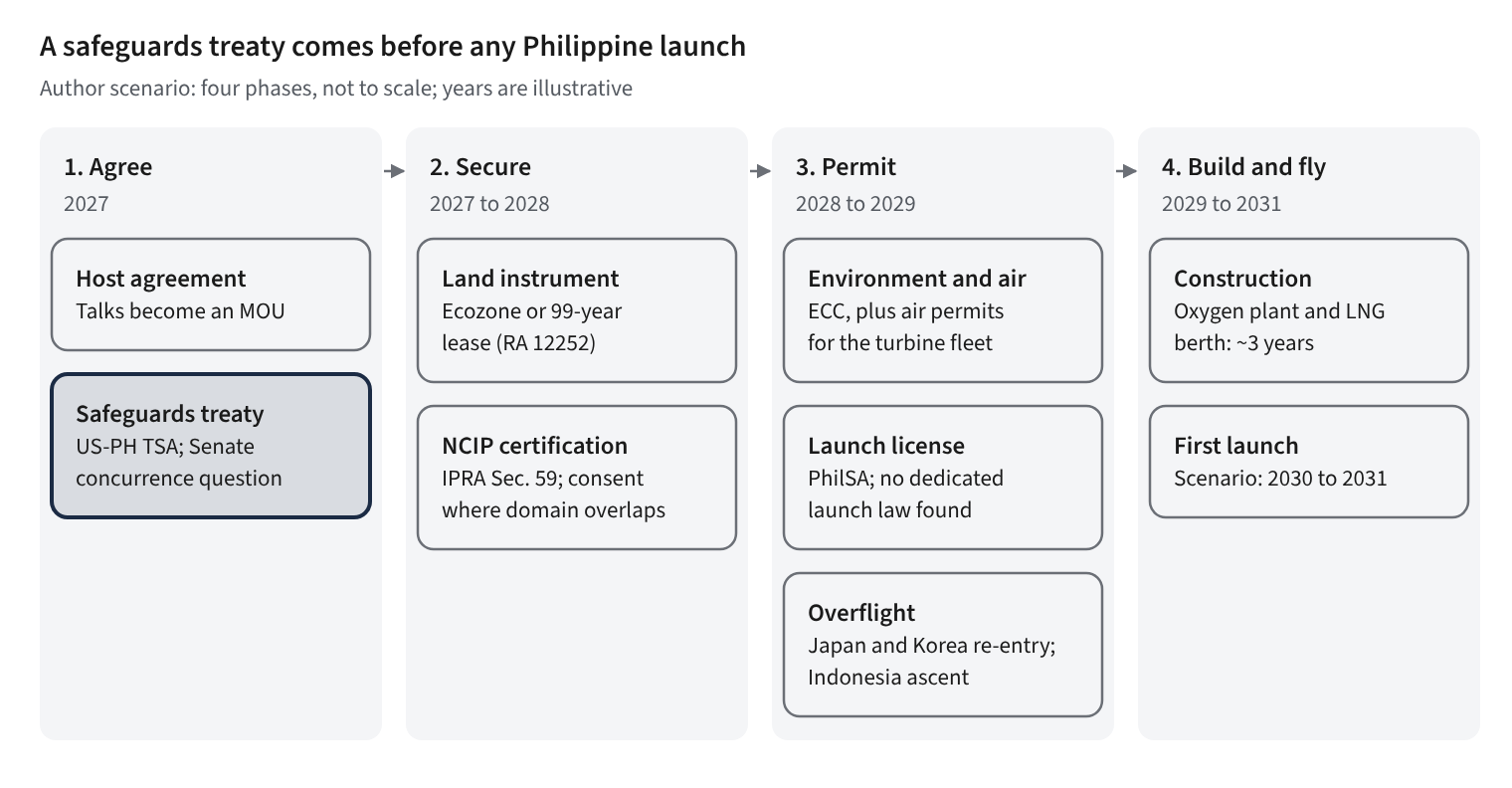
Figure D4. Permitting path in four phases: agree, secure, permit, and build and fly. The safeguards treaty gates everything after it. Author scenario; years are illustrative.
Process unique to a launch site
| Item | Why it is unique to launch | Lead body | Lead time [A] |
|---|---|---|---|
| Technology Safeguards Agreement | No US launch without one; fixes custody of US hardware and data | US State Department and DFA | 1–3 years. Australia's took about nine months from signature to entry into force, after parliamentary review [D] |
| Launch and re-entry authorization | No dedicated Philippine launch-licensing regime found; PhilSA's stated goal is predictable licensing timelines [D] | PhilSA | 1–2 years to write rules |
| Range: hazard areas and closures | Up to six closures a day at Phase 3 | CAAP; Philippine Coast Guard | Built alongside the site |
| Overflight and re-entry | Ascent toward Indonesian waters or past Yonaguni; return over Japan or Korea at altitude | DFA with Tokyo, Seoul, Jakarta | 1–2 years, in parallel |
| Air permits for a turbine fleet | SpaceX's AI subsidiary has been sued for allegedly running 27 turbines without an air permit in Mississippi [D] | DENR Environmental Management Bureau (Clean Air Act, RA 8749) | 6–18 months; litigation risk |
| LNG berth and storage | First LNG facility outside Batangas | Department of Energy; Philippine Ports Authority | 2–3 years including construction |
| Captive power and water | 50–490 MW of self-generation; seawater intake | Energy Regulatory Commission; National Water Resources Board | Months, in parallel |
| International liability | Launch-state liability under the UN space treaties | DFA; PhilSA | Settled in the safeguards and host agreements |
| US export controls | Raptors, avionics, and payload data | US State and Commerce Departments | Standing licenses |
Coastal ecology and fisheries. Beyond air permits, the triggers most likely to be litigated in the Philippines are reefs and marine protected areas near berths and outfalls; thermal and brine discharge from desalination; and artisanal fisherfolk who lose fishing grounds to up to six maritime closures a day. Municipal waters, out to 15 km from shore, fall under local government jurisdiction under the Fisheries Code, so the municipality is a permitting party, not just a host. Closure scheduling, fisheries compensation, and early consultation are the levers. [I]
The critical path
Treaty, then land and consent, then environmental and air permits, then a three-year build of the oxygen plant and LNG berth. Technip's reported 36-month schedule for Louisiana's methane plant is a fair proxy. [D] Run in sequence, that lands a first launch in 2030–31 at the earliest. The lever is to run land, consent, and permitting in parallel with treaty negotiation, on government land inside an economic zone, which removes the most litigation-prone gates. [I]
Bottleneck register
Every binding constraint in one table. "Binds at" is the phase where it first limits the site. The lever is what loosens it; the signpost is what a reader would see if someone were pulling that lever. [I]
| # | Bottleneck | Type | Binds at | Lead time | Lever | Residual risk | Signpost |
|---|---|---|---|---|---|---|---|
| B1 | US–Philippines Technology Safeguards Agreement | Schedule | Before anything | 1–3 years | Negotiate in parallel with site work; executive-agreement route | Senate concurrence fight | Announcement or negotiation notice |
| B2 | Launch licensing regime | Schedule | Before first launch | 1–2 years | PhilSA implementing rules modeled on FAA Part 450 | Untested regulator | Draft rules published |
| B3 | Land at the pad site | Schedule | Before construction | 1–3 years | Government land in an economic zone; mining tenement (Homonhon); 99-year lease | Smallholder title disputes | New ecozone proclamation on the Pacific coast |
| B4 | Hazard and acoustic buffer | Engineering and schedule | Before construction | With land | Headland sites where the buffer falls over sea | Relocating residents on small islands | Resettlement plans |
| B5 | Indigenous consent | Schedule | Before construction | 1–2 years | Avoid ancestral domains; early consent process | Pusan Point's Mandaya uplands | NCIP field investigation opened |
| B6 | Environmental, air and coastal permits | Schedule | Before operation | 6–24 months | Programmatic EIS for an ecozone; phased air permits; Megablocks to cut turbine run-hours; and fisheries compensation | Litigation, as in Mississippi; reef and fisheries challenges | DENR-EMB filings |
| B7 | Gas supply | Operational | Phase 1 | 2–3 years (berth and contract) | Long-term contract; dedicated carrier shuttle; Batangas reload | Price spikes; typhoon interruptions | LNG berth or contract with no obvious buyer |
| B8 | Oxygen plant scale | Engineering | Phase 2 | ~3 years | Modular trains; exhaust-heat precooling | Energy at 0.9 MWh/t would add ~95 MW | Industrial-gas contractor engaged |
| B9 | Power plant | Engineering | Phase 2 | 1–2 years | SpaceX's own turbines, simple cycle with heat recovery; Megablock reserve | Turbine competition with data centers | Turbine import or air-permit filing |
| B10 | Seismic and tsunami exposure | Engineering | Day one | Design choice | Seismic loads; setback and elevation; vertical evacuation | Philippine Trench event with minutes of warning | PHIVOLCS hazard studies commissioned |
| B11 | Dawn-dusk launch windows | Orbital and operational | Phase 2–3 | Design choice | Two-way site (Pusan Point); planes spread across LTANs; both pads per window | Cadence cap at one-direction sites | — |
| B12 | Launch and return on the same pass | Operational | Phase 2 at Jomalig and Patnanungan | Design choice | Dedicated catch tower or third pad | Range congestion | Third tower in plans |
| B13 | Corridor precision | Orbital | Day one | Fixed by site | Choose a clean site; small dog-legs | Lal-lo cannot fly dawn-dusk cleanly | Site named |
| B14 | Re-entry overflight | Orbital and diplomatic | First return | 1–2 years | Arrive from the north; cross-range; notification arrangements with Japan and Korea | Political objection | Diplomatic traffic with Tokyo or Seoul |
| B15 | Regional geopolitics | Diplomatic | Throughout | Ongoing | Frame as civil and commercial; transparency on closures | Chinese diplomatic and gray-zone pressure | Coast Guard incidents in closure areas |
| B16 | Ship replacement | Operational | Phase 3 | 2–3 years for a factory | Local stage factory at a nearby port | Shipping 42 ships a year from Texas | Factory land at a port |
| B17 | Payload flow | Operational | Phase 2 | 1–2 years | Secure processing under US custody; dedicated freight | Satellite factory output | Payload-processing building |
| B18 | Range operations | Operational | Phase 2 | 2–3 years | A 24-hour range center with CAAP and the Coast Guard | Shipping and fishing disruption | Range-safety office created |
| B19 | Typhoon season | Engineering and operational | Every year | — | Design loads; 30-day gas reserve; schedule margin; southern site | Lost cadence | — |
Reading the register. Rows B1 to B6 are mostly schedule. They decide when, and they are mostly government actions. Rows B7 to B10 decide how big, and they turn on gas. Rows B11 to B15 decide where, and they are fixed the day a site is chosen. That is why the site choice matters more than anything that follows it. [I]
Site implications
The screen
Twelve Pacific-facing sites were screened for corridors, then checked against protected-area law, population, and land use. These are outputs of a screen; nobody is known to be considering any of them (Figure D2). [I]
- Eliminated by law despite good geometry: Siargao and Bucas Grande (protected landscape and seascape); Suluan, Calicoan, and the Guiuan group (protected landscape and seascape; Suluan was the first place Haiyan struck); Pujada Island (protected seascape). [D]
- Shortlist: Pusan Point (mainland, Caraga, Davao Oriental; 39,704 people in the municipality; a Mandaya ancestral-domain title covers about 14,000 ha of the uplands). Homonhon (4,722 people; 6,489 of 7,400 ha under mining contracts; inside the Guiuan protected area; Magellan's landing site). Jomalig (7,884 people; 5,665 ha, mostly agricultural). Patnanungan (15,052 people; 139 km²; a pending tourism-zone bill). [D]
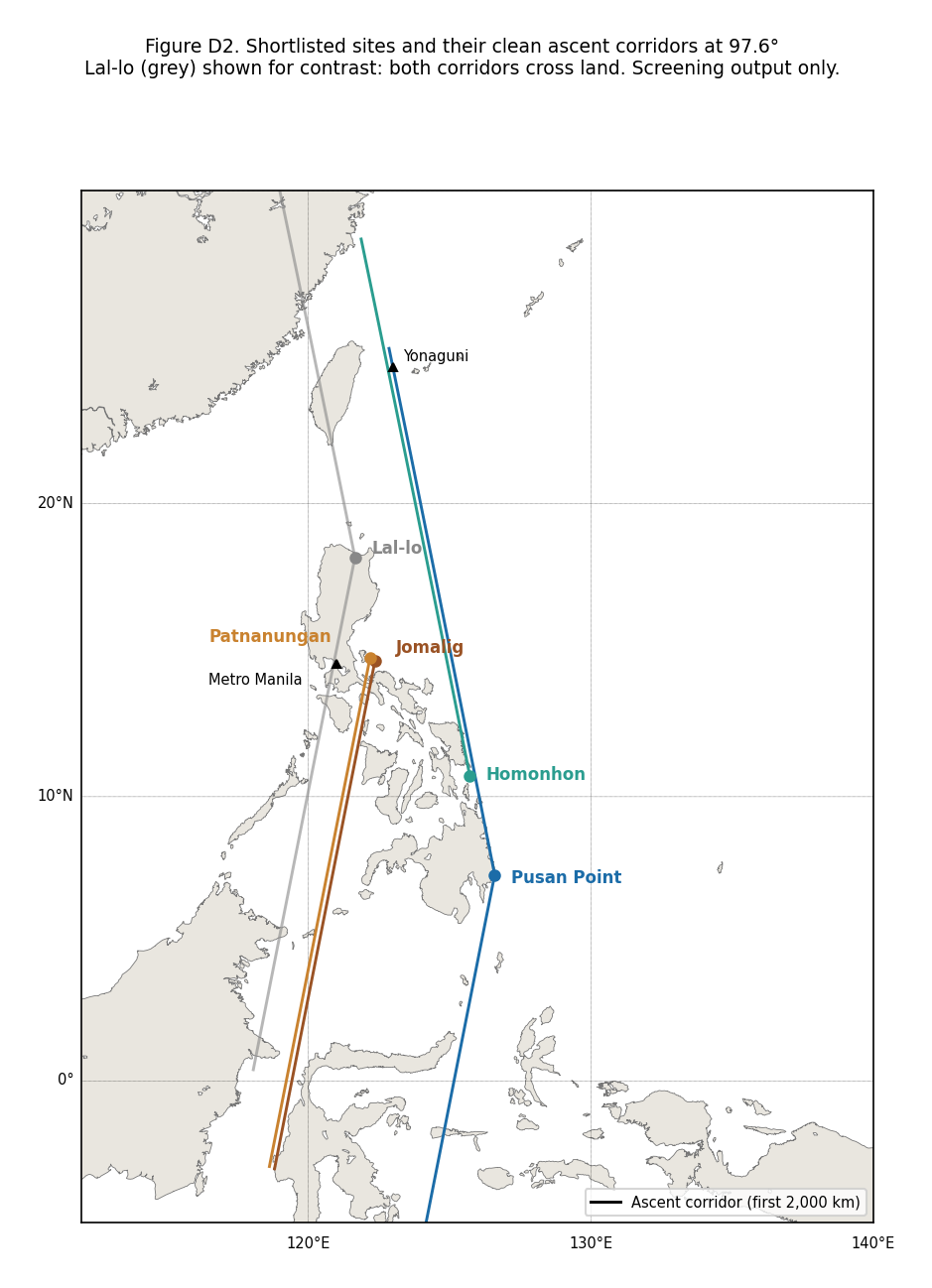 Figure D2. The four shortlisted sites and their clean ascent corridors at 97.6°, with Yonaguni and Metro Manila marked. Lal-lo (gray) shown for contrast. Screening output only.
Gate first, then score
For AI satellites, a site that cannot reach dawn-dusk orbit cleanly does not qualify for that mission, however good it is otherwise. Gate: at least one direction with 6% land or less, using a dog-leg of 1° or less. [I]
| Site | Passes the gate? | Note |
|---|---|---|
| Pusan Point | Yes, both directions | |
| Homonhon | Yes, northbound | |
| Jomalig | Yes, southbound with 0.5° | A needle |
| Patnanungan | Yes, southbound | |
| Lal-lo | No | Qualifies only for the 30° shell, half of the FCC filing |
| Pecan Island (reference) | No, at 15% | SpaceX chose it anyway; the calibration point |
Scores for the sites that pass (1 = poor, 5 = strong; weights in brackets; author's judgment) [I]
| Criterion | Pecan Island | Pusan Point | Homonhon | Patnanungan | Jomalig |
|---|---|---|---|---|---|
| Orbit: corridors, windows, and return (20) | 3 | 5 | 4 | 3 | 3 |
| Land control at scale, including hazard buffer (15) | 5 | 2 | 4 | 3 | 2 |
| Permitting path (20) | 4 | 3 | 2 | 3 | 3 |
| Port and logistics (10) | 5 | 2 | 3 | 2 | 2 |
| Propellant and power (10) | 5 | 1 | 1 | 1 | 1 |
| Typhoon, seismic, and tsunami hazard (10) | 2 | 2 | 1 | 2 | 2 |
| Community and political risk (10) | 4 | 2 | 2 | 2 | 3 |
| Overflight and geopolitics (5) | 3 | 3 | 3 | 4 | 4 |
| Score (of 100) | 78 | 55 | 53 | 51 | 50 |
| Score if orbit is weighted 35 | 76 | 61 | 57 | 52 | 51 |
Pusan Point leads because it is the only two-way site: two windows a day and a clean return, so northbound launches and catches never compete for the same window. Its hazard score drops to 2 because Bopha's 2012 landfall and the October 2025 trench earthquake were both next door. Pecan Island drops to 3 on overflight, because its polar ascent crosses Mexico and its return crosses Guatemala. Homonhon is the brownfield alternative. The Polillo pair, Jomalig and Patnanungan, works best together, though the hazard buffer, below, weighs hardest on them. The gap to Louisiana is land, gas, and power, not geometry. [I]
Multi-island trade
| Concept | At the pad site | Elsewhere | For | Against | Fits |
|---|---|---|---|---|---|
| A. Integrated (the Pecan model) | Everything | Nothing | Simplest operations | Thousands of hectares under one control, with housing next to the hazard area | Homonhon (tenements); Pusan Point |
| B. Pad site plus port (base case) | Pads, oxygen plant, turbines, LNG berth, tanks, desalination | Port: payload processing, housing, later stage production | Smallest pad footprint; existing ecozone labor | Barge link exposed to typhoons | Pusan Point, Jomalig, Patnanungan |
| C. Pad site plus energy island | Pads, tanks, oxygen plant | LNG terminal and turbines on a neighboring island, linked by subsea cable | Gas plant and its air permits off the pad site | 150–490 MW of cable as a single point of failure | Polillo: power on Patnanungan, pads on Jomalig |
| D. Shipped propellant | Pads only | Oxygen and methane barged in | Minimal pad site | 5,690 t of liquid oxygen a launch, every day | Rejected |
Fence versus buffer. A two-pad site with its tank farm, oxygen plant, and power systems needs a fenced industrial area of roughly 400–800 ha. [A] That is not the hazard area. Daily launches and catches of the largest rocket ever built need an acoustic, overpressure, and sonic-boom buffer, assumed here at 3–5 km from each pad. [A] A 4 km radius is about 5,000 ha, nearly the whole of Jomalig (5,665 ha, about 7,900 people). On a populated small island the buffer, not the fence, is the binding land constraint. On a headland like Pusan Point, much of the buffer arc falls over the Pacific. That is a further point for Concept B (Figure D5) at Pusan Point, and a reason Concept C would put the pads on the less populated island of a pair. [I]
Why not offshore platforms? SpaceX bought two oil rigs in 2020 to convert into Starship launch platforms, then sold them. Gwynne Shotwell: "We bought them. We sold them. They were not the right platform." [D] SpaceX still expects offshore platforms to play a role eventually at very high cadence. [D] For this mission the oxygen plant settles it: 120–360 MW of power, 5,700–17,000 t a day of liquid oxygen and 30 days of LNG storage do not float easily in a typhoon belt. A platform might take the pad and its buffer offshore, with propellant shuttled from land. That is a Concept B variant worth watching, not the base case. [I]
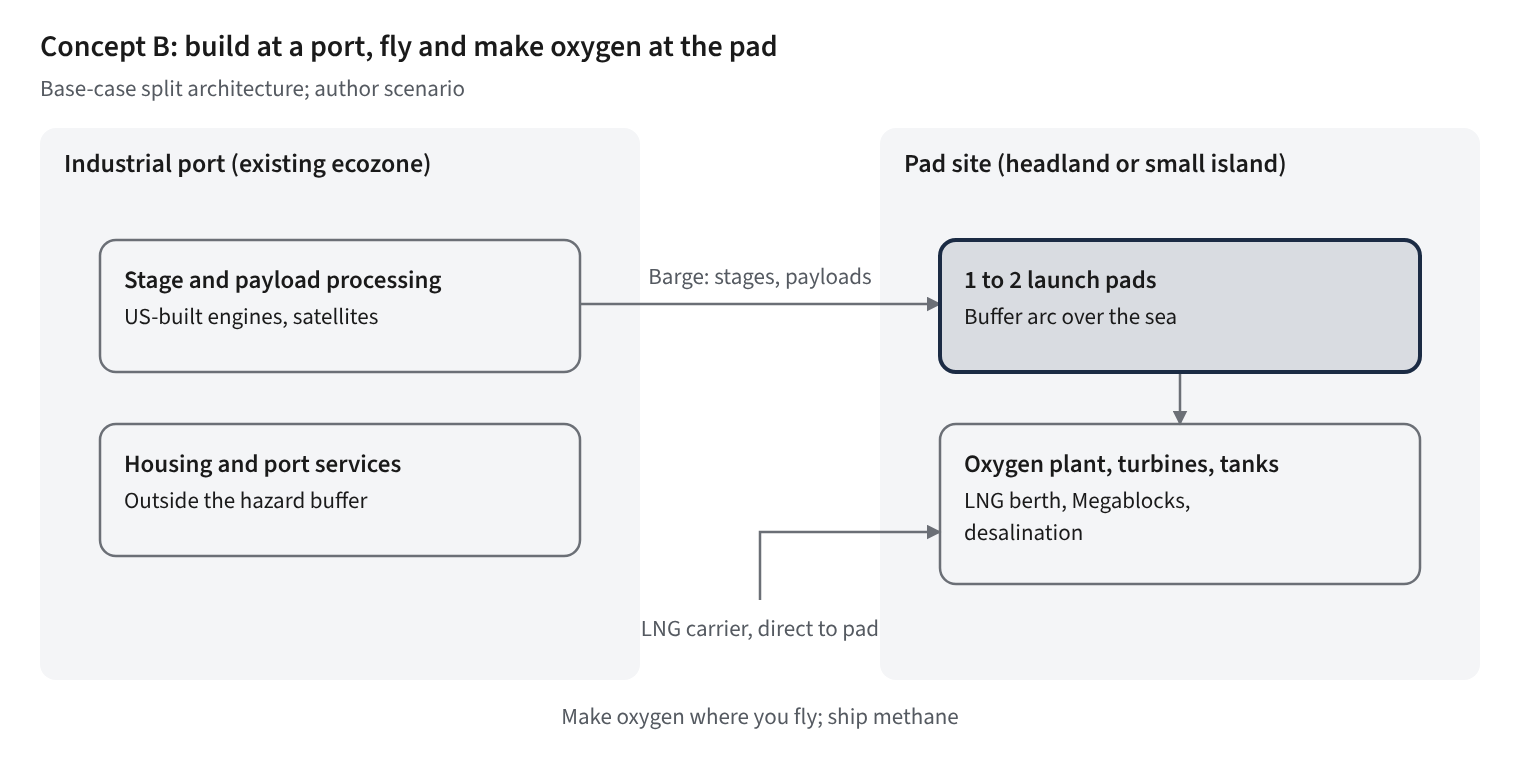
Figure D5. Concept B, the base case: stages and payloads are processed at an existing industrial port and barged to a headland or small-island pad site, which makes its own oxygen from LNG delivered direct. Author scenario.
Side by side: Louisiana and a Pacific annex
| Starbase Louisiana (announced) | Pacific annex (this study's base case) | |
|---|---|---|
| Status | Announced Aug. 25, 2026 [D] | Early talks confirmed Nov. 20, 2026; no site named [D] |
| Land | ~125,000 acres, largely one former Exxon Mobil holding [D] | 400–800 ha fenced pad site plus port facilities [A] |
| Pads | 10, in 5 complexes [D] | 2 [A] |
| Launches a year | Musk: 10,000 [D] | 52 → 365 → 1,095 [A] |
| Payload to dawn-dusk orbit per V4 | ~142 t, with a corridor crossing Mexico [I] | ~142 t on a cleaner corridor [I] |
| Ship return | From the south, over Yucatán and Guatemala [I] | From the north; clean final 1,500 km [I] |
| Gas | On the US Gulf Coast gas system [D] | Imported LNG, 0.15–2.4 Mt a year [I] |
| Power | On-site generation planned [D] | 50–490 MW of gas turbines plus Megablocks [I] |
| Regulator | FAA, an established regime [D] | PhilSA, with no dedicated launch law found [D] [I] |
| Treaty needed | None | US–Philippines Technology Safeguards Agreement [I] |
| First launch | 2029 planned [D] | 2030–31 at the earliest [I] |
What the comparison suggests. The annex does not compete with Louisiana; it complements it. It adds a second weather window, a second regulator, a cleaner polar corridor, a clean return path, and launch capacity next to Asian customers. It is also a diplomatic object: for Washington an alliance anchor in space, for Manila the spaceport PhilSA has been seeking. [I]
It also changes the debris story. Today the Philippines receives spent stages from Chinese launches in its waters. A Starship annex would launch from Philippine soil and leave nothing behind downrange. [I]
Risks and signposts
Risks to the scenario
| Risk | Effect | Likelihood (author) |
|---|---|---|
| Orbital compute disappoints commercially; SpaceX's own filing warns it may not achieve viability [D] | Demand for a second polar gateway disappears | Medium |
| Louisiana and Florida absorb all polar demand, accepting Mexico overflight | No need for a Pacific site | Medium |
| Rapid reuse matures more slowly than SpaceX says | Cadence and fleet numbers slide right | Medium–high |
| Safeguards agreement stalls in the Senate concurrence debate | Schedule slides by years | Medium |
| Regional friction: a US-custody heavy-lift site in a treaty ally, flying past Yonaguni about 110 km from Taiwan, will not be read in Beijing as purely commercial | Diplomatic pressure; gray-zone interference with maritime closure areas; insurance and enforcement costs | Medium–high |
| Philippine Trench earthquake or tsunami | Damage to towers, tanks, and LNG jetty; loss of life | Low annual, high consequence |
| LNG price spike or supply disruption | Operating cost; cadence | Medium |
| Local opposition or litigation over land, air, reefs, or fisheries | Site lost or delayed | Medium |
| Atmospheric impact of high cadence and re-entry becomes a policy issue; a new study estimates the million-satellite plan could raise upper-atmosphere pollution more than a hundredfold [D] | Regulatory drag in all jurisdictions | Rising |
Signposts, in likely order
- A Technology Safeguards Agreement announced or under negotiation. The lead indicator.
- PhilSA launch-licensing rules in draft.
- A new or expanded economic-zone proclamation on the Pacific coast: Davao Oriental, Eastern Samar, or the Polillo group.
- Land activity: a 99-year lease under RA 12252, or a mining tenement on Homonhon changing hands or terms.
- An NCIP field investigation or consent process in a coastal municipality.
- An LNG berth, supply contract, or small-carrier charter with no obvious buyer.
- An industrial-gas contractor or turbine shipment bound for the east coast.
- Diplomatic traffic with Tokyo, Seoul, or Jakarta about overflight and re-entry.
- Hiring: permitting, range-safety, or government-relations roles in the Philippines.
What would weaken the case
- Talks stay at Lal-lo, at 30° or sounding-rocket scale.
- The project is framed as Starlink ground or manufacturing presence, with no launch.
- The dawn-dusk share of the FCC filing shrinks, or AI satellites move to the 30° shells.
Key uncertainties
The analysis rests on inputs SpaceX has not published and on screens that are not yet full engineering studies. The ones that move the answer most:
- AI1 mass. Not published. The base case assumes about 2 t (bounded 1.2–2.5 t); a published critique implies about 6 t, which cuts every compute-per-launch figure by about two-thirds.
- Starship V4 performance. Payload and the ship dry mass behind the payload-per-m/s rate (200 t assumed; 150–300 t tested) are the author's assumptions.
- Corridors are a screen, not a trajectory analysis. Ground tracks and land fractions rank the sites; a full trajectory tool with lofting and staging points would refine them.
- Oxygen-plant energy. The largest engineering sensitivity: 0.5 MWh per metric ton of liquid oxygen assumed, in a 0.3–0.9 range.
- Hazard buffer and fence size. The 3–5 km buffer and 400–800 ha fence are assumptions, not sourced figures.
- Site checks not yet done. Protected-area boundaries, ancestral-domain overlaps, mining tenements, tsunami and ground-shaking hazard maps, and typhoon days lost per season have not been confirmed site by site.
- Treaty status. The Philippines' position under the Liability and Registration Conventions, and the air-permit path for site turbines, are unconfirmed.
Each input is listed in the assumptions register with what changes if it is wrong. Corrections are welcome and will be logged.
Sources
SpaceX vehicle, payload, and plans
- SpaceX FCC application for orbital data-center satellites (Jan 2026) and dawn-dusk supplement; SpaceX statement on 100 kW per metric ton and 100 GW a year (via DatacenterDynamics, Nov 2026).
- Musk interview, "Elon Musk on Space GPUs, AI, Optimus, and his manufacturing method" (Cheeky Pint, early 2026): "We're doing 100 kilowatts per ton."
- AI1 specifications (Light Reading, Jun 2026); Gigasat factory (Tom's Hardware, Jun. 9, 2026); Starmind announcement (Aug 2026).
- Starship V3 reporting (Raptor 3, 280 tf; more than 100 t reusable; interstage changes); Musk on V4 (Nov. 16, 2026, via Teslarati and Tesla North).
- Flight 15 ship catch (Space.com, Fox Business, IBTimes, Nov. 14–15, 2026); Musk on reflight timing (Aug–Sep 2026).
- SpaceX statement to the FAA anticipating 10,000 launches a year; Musk on Starbase Louisiana (Oct 2026).
- SpaceX S-1 descriptions of the McGregor, Hawthorne, Redmond, and Bastrop facilities.
- SpaceX turbines: Texas application (TechRadar, Nov 2026); IPO turbine commitments (Gizmodo; Motley Fool); blade casting (Tom's Hardware, Aug 2026).
- Starpipe filings (Reuters via multiple outlets, Jun 2026); Technip Energies' Louisiana methane bid (Construction Review Online).
Louisiana and Philippine context
- Starbase Louisiana announcement and coverage (Louisiana Economic Development; Reuters; Manufacturing Dive, Aug 2026).
- President Marcos's statement (Nov. 20, 2026); PhilSA statements on Lal-lo and spaceport policy; Ambassador Romualdez's remarks, including InsiderPH's report of Feb. 12, 2025 on a possible Mindanao launch site and DICT Secretary Ivan Uy's response.
- RA 11363 (Space Act); RA 12252 and implementing rules; RA 8371 (IPRA) §59; PD 1586 and Proclamation 2146; RA 8749 (Clean Air Act).
- Protected-area records for Siargao and Bucas Grande, Guiuan, and Pujada Bay; Philippine Statistics Authority census; municipal profiles; Mandaya CADT records.
- Philippine LNG: ICIS; GIIGNL; US Commercial Service; Reuters (Oct 2025) on terminal use.
- US Technology Safeguards Agreements with New Zealand, Brazil, the UK, and Australia.
Engineering references
- Tesla Megapack 3 and Megablock specifications (Sep 2025 launch coverage).
- NREL, Land-Use Requirements for Solar Power Plants in the United States (2013).
- Air-separation energy (Thunder Said Energy; peer-reviewed ASU literature); LNG cold-energy ASU studies (Energy, 2015 and 2025); Wärtsilä small-scale liquefaction data.
- FAA 2022 Starbase environmental assessment (deluge volume); Starbase Pad 2 deluge tests (2026).
- Atmospheric-impact study of the million-satellite plan (Scientific American, Nov 2026).
Added after external review
- Bolinger and Bolinger, "Land Requirements for Utility-Scale PV: An Empirical Update on Power and Energy Density," IEEE Journal of Photovoltaics (LBNL, 2022).
- PHIVOLCS primer and tsunami information on the October 10, 2025 magnitude 7.4 offshore Davao Oriental earthquake; PHIVOLCS on 2–15 minute evacuation windows (via GMA News, 2025).
- Typhoon Bopha (Pablo) landfall at Baganga, Davao Oriental (PAGASA via Inquirer and MindaNews, December 2012; Weather Underground).
- SpaceX's purchase and sale of the Phobos and Deimos rigs; Shotwell's remarks (SpaceNews, February 2023).
Method
- Author's scripts: corridor geometry (ground tracks on a rotating Earth, land mask); orbital trades (rotation penalty, plane-change cost, payload sensitivity); mass and energy balance; fleet and throughput. Available on request.